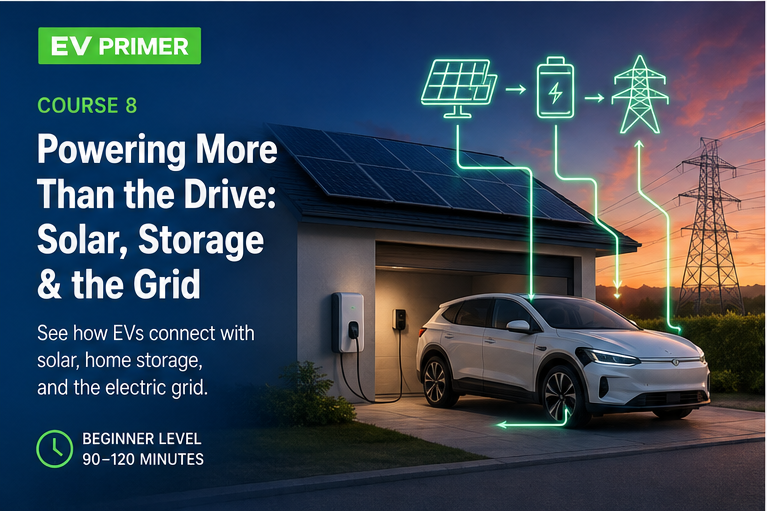
An EV is a transportation device and a significant electrical load. This beginner course explains how EV charging interacts with the home electrical system, utility rates, solar generation, stationary battery storage, managed charging, demand response, vehicle-to-home, vehicle-to-building, vehicle-to-grid, and emergency backup concepts. It emphasizes safety, qualified electrical work, current code and utility verification, and realistic expectations.

Learning objective: Explain EV charging as an electrical load and connect power, energy, and household capacity.
Learning objective: Explain how utility pricing and managed charging affect EV cost and grid impact.

Learning objective: Explain how solar production can support EV charging without oversimplifying the relationship.
Learning objective: Describe stationary storage, backup loads, and resilience planning at a beginner level.
Learning objective: Distinguish major bidirectional and power-export concepts.
Learning objective: Explain how aggregated EVs and batteries may support grid services.
Learning objective: Identify the major safety and approval boundaries for EV-energy projects.
Learning objective: Create a beginner EV energy plan that connects charging, solar, storage, rates, resilience, and verification.