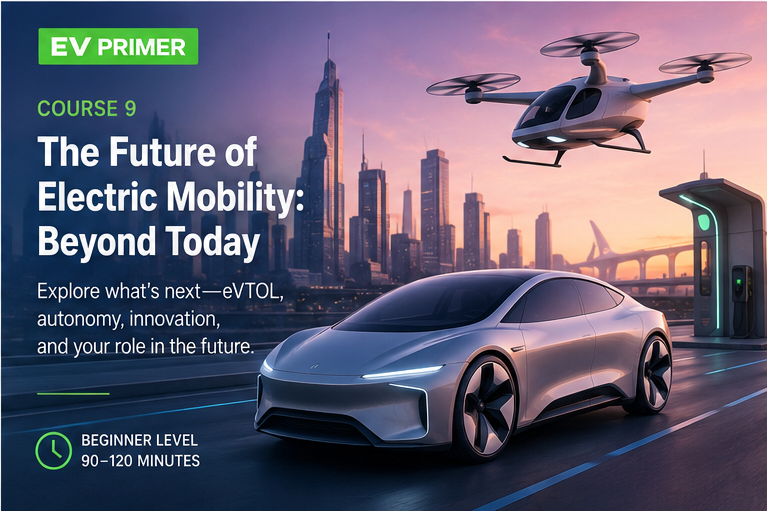
Electric mobility continues to expand beyond today’s passenger EVs. This capstone course introduces future-facing topics including driver assistance, autonomy, robotaxis, electric fleets, electric school buses and trucks, micromobility, marine and off-road electrification, eVTOL aircraft, advanced air mobility, charging corridors, workforce pathways, fusion-energy context, and the difference between prototypes, pilots, and deployed services. It ends with a cumulative EV Primer review and next-step learning plan.

Learning objective: Distinguish driver-assistance features from automated driving claims.
Learning objective: Explain robotaxis and shared mobility without confusing pilots with universal deployment.

Learning objective: Explain how fleet electrification differs from individual EV ownership.
Learning objective: Identify electric platforms beyond passenger cars and trucks.
Learning objective: Introduce eVTOL and advanced air mobility with realistic deployment boundaries.
Learning objective: Distinguish technology stages and place fusion energy in long-term context.
Learning objective: Review the central concepts from the full nine-course EV Primer.
Learning objective: Identify responsible next steps after completing the EV Primer.